
Introduction
There are generally three stages that an internationally trained lawyer (“ITL”) must complete to qualify as a barrister and solicitor in Canada:*
1. The NCA assessment process;**
2. Articling; and
3. Provincial Bar requirements.
Each stage is summarized in the sections that follow.***
*Except Quebec, which is a civil law jurisdiction with different several stages of training, including professional and practical training through the Barreau du Québec followed by an internship during which the candidate will be able to pose, under the supervision of a training supervisor, all the acts that fall under the exclusive jurisdiction of the lawyer. Click here for more official information (in French).
**GLC facilitates a comprehensive list of WhatsApp chat groups to aid those going through the NCA assessment process. The most updated information can be found at the end of this page.
***In Quebec, both (Canadian) common law lawyers, as well as ITLs must obtain a temporary restrictive or a full permit in order to become a member of the Barreau du Québec and be authorized to practice the profession in such province. Click here for more official information (in French).
1. The NCA assessment process
The National Committee on Accreditation (“NCA”) is a standing committee of the Federation of Law Societies of Canada (“FLSC”). The mandate of the NCA is to help Canada’s common law law societies protect the public interest by assessing the legal education and professional experience of individuals who obtained their credentials outside of Canada or in a Canadian civil law program.
An assessment is done before an individual may apply for admission to a law society in a Canadian common law jurisdiction, and is based on the academic and professional profile of each applicant.
Each application is assessed on an individual basis, taking into account the specific elements of each applicant’s educational and professional background, as stated in NCA Policies. The NCA applies a uniform standard on a national basis so that applicants with common law qualifications obtained outside of Canada do not need to satisfy different entrance standards to practice law in the different common law provinces and territories of Canada.
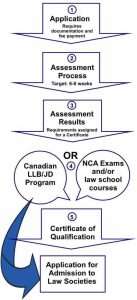
The NCA flow chart below illustrates the five step process involved in each NCA assessment:
1) You submit your online application (click here) with required documentation and payment;
2) Once your file is complete, the NCA reviews and assesses your credentials;
3) The NCA notifies you of assignments or deficiencies;
4) You complete your assigned requirements; and
5) The NCA issues a Certificate of Qualification – which is required to apply to a Canadian law society in a common law jurisdiction.
NCA programs at Canadian law schools
While meeting Step 4 assigned requirements to the NCA process, if any recognition is given for a NCA candidate’s degree, there are currently four law schools in Canada that allow NCA candidates to complete all or a portion of their assigned NCA exams content: either on an individual exam course basis or as a postgraduate degree, or even providing preparation courses so NCA candidates can take the said exams.
Each Canadian law school has different program admission requirements. Below is a list of Canadian law schools which assists NCA candidates in getting through the NCA accreditation and licensing process.
Please note that it is not a requirement to complete your NCA exams through the below law schools, and is merely provided as an option for you to consider.
Click on them to find out more:
Alberta
British Columbia
Ontario
- Osgoode Hall Law School, York University – Admission to take selected courses in the JD Program
- Osgoode Hall Law School, York University – Osgoode Professional Development NCA Exam Prep Program (online)
- Osgoode Hall Law School, York University – Professional LLM in Canadian Common Law
- University of Toronto, Faculty of Law – Admission to take selected courses in the JD Program
- University of Toronto, Faculty of Law – Global Professional Master of Laws Program
- University of Toronto, Faculty of Law – Internationally Trained Lawyers Program
- Ryerson University, Faculty of Law – JD program*
*Though Ryerson University’s preliminary approved juris doctor (JD) program is not truly meant for NCA candidates, it has a unique integrated practice curriculum (IPC). This means Ryerson JD candidates have a mandatory professional placement, as well as immersive bootcamps designed to teach students everything from coding to innovative business skills. That said, Ryerson JD candidates will still be expected to fulfill any remaining provincial and/or territory bar requirements.
2. Articling
In Canada, articling follows the completion of a law degree and serves as a training year. The completion of this year qualifies you to be admitted as a practicing member of a province’s law society. During the articling year you’ll be supervised by a member of the bar for that province or territory, attend bar admission classes, and write the bar exam(s) if applicable.
Canadian law students are often offered articling positions following one or two paid summer terms with a legal employer. If not, many national and regional firms still conduct recurring articling interviews during summer after their second year or during their last third year of studies.
It is important to note that since the regular Canadian recruitment system is not meant for ITLs, such candidates will rarely be successful when applying for these summer roles, as they are specifically meant for year one (L1) and year two (L2) students.
However ITLs are eligible to apply for all articling positions during the regular articling recruitment season by national and regional firms, and throughout the rest of the year with smaller firms, depending on their specific needs (and budget). Keep in mind a Certificate of Qualification (per the first stage above), must be obtained prior to starting articling -if not sooner depending on the specific law firm requirements for ITLs.
If you are looking for an articling position, there are many online resources available including the following:
- viLawPortal (though primarily used by Canadian law students, ITLs are not prevented from registering as a Student, and applying for both summer and articling positions).
- The National Association for Law Placement (NALP) (excellent resource on most national and regional law firms, areas of practice, recruitment contacts, etc.)
- Canadian Bar Association Job Boards
- Law Society of Ontario Articling Registry
- Indeed.ca (search “articling student” and “Student-at-law”)
- Wowjobs.ca (search “articling student” and “Student-at-law”)
Law Practice Program (Ontario only)
On December 10, 2018, the Law Society of Ontario’s governing body approved an option for lawyer licensing that retains both Articling and the Law Practice Program/Programme de Pratique du droit (LPP/PPD) as two transitional pathways to licensing.
Candidates entering or currently registered in the Law Society of Ontario’s Lawyer Licensing Process may choose from two experiential training paths that include either the Articling Program or the LPP/PPD. Both of these training paths will satisfy the experiential training component of the Lawyer Licensing Process.
The LPP consists of a four-month training course and a four-month work placement. Candidates who select the LPP experiential training path must complete both the training course and the work placement. The program runs consecutively from late August/early September until the end of April. Presently, Ryerson University provides the English program and the University of Ottawa provides the French program.
You can find out more information about the LPP/PPD program on the Law Society of Ontario’s website here.
Candidates are also encouraged to regularly consult Ryerson University’s Law Practice Program for more information, and the University of Ottawa’s Law Practice Program website in English or French.
Ryerson University Integrated Practice Curriculum JD Program (Ontario only)
On 25 April 2019, The Law Society of Ontario’s (LSO) Convocation unanimously voted to approve Ryerson University’s application to have its juris doctor (JD) program designated as an integrated practice curriculum (IPC).
An IPC integrates the “teaching of substantive law with the acquisition of skills and competencies.” Following the completion of an IPC, candidates are required to successfully complete licensing examinations and to fulfil the LSO’s good character requirement in order to be licensed as lawyers. Ryerson JD students will not be required to article or complete the LPP/PPD.
Find out more at Ryerson University Faculty of Law’s website.
3. Provincial Bar requirements
Each common law province and territory in Canada has similar yet diverse requirements for admission to the Bar. Some require that you take certain courses while in law school, others simply require you to have completed law school.
It is important to determine which provinces you might want to practice in and to review their requirements. These requirements change frequently. If in doubt contact the Bar Society for the common law province or territory you are interested in. It is important to map this out early so you can anticipate the necessary time and costs associated with this process.
Please visit the appropriate provincial law society as listed in our Governing Bodies tab here.
GLC Whatsapp Groups
Per section 1. The NCA assessment process above, we launched in 2018 a free entry/exit discussion groups through the well known WhatsApp phone platform, which simply requires a new (or existing) account, and can be additionally accessed through other devices via the WhatsApp Web feature.
NCA – Common Law Forum (click here from your mobile device), our main discussion group for Common Law ITLs, for any general questions and spam filter group to gain individual access to our sixteen NCA exam specific subgroups (covering ALL five mandatory, three core subjects and additional eight subjects per NCA’s latest Policies and Guidelines):
- NCA – Constitutional Law
- NCA – Administrative Law
- NCA – Criminal Law
- NCA – Foundations of Canadian Law
- NCA – Professional Resp
- NCA – Contracts
- NCA – Property
- NCA – Torts
- NCA – NCA Evidence
- NCA – Trusts
- NCA – Business Organizations
- NCA – Civil Procedure
- NCA – Commercial Law
- NCA – Family Law
- NCA – Remedies
- NCA – Tax Law
NCA – Civil Law Forum (click here from your mobile device), our secondary forum for ITLs from a civil law* jurisdiction – given how different the above can be when compared to their common law peers.
* For clarity, civil law Jurisdictions are those which lack substantive Common Law Components to their Legal Systems, meaning those countries not included in either Appendix A or B to the current Policies and Guidelines of the NCA.
All groups above are here to stay (meaning will always be available regardless of the date sessions posted by NCA, members are free to join,leave and even rejoin as needed.
We only request keeping discussions free of any unrelated NCA topic, including commercial postings of any kind (as GLC does not endorse any third party provider; however, free introductory courses and/or complementary advice from current third party tutors is always acceptable).
Finally, given that GLC is solely facilitating the use of these groups (while allowing those who join to share any related content as needed); GLC reserves the right to delete posts and permanently ban for life anyone phishing spamming spoofing and sniffing, and/or continuing to distribute unrelated content (despite a written post warning).
Similarly, GLC reserves the right to delete posts and temporary or permanently ban anyone distributing actual photos and/or content of current NCA examinations, as well as any third party study material commercially licensed under copyright law in Canada. With this in mind, we will only take action upon email notice to us by the rightful copyright owner, with reasonable proof of infringement for our comparison.